Did colonial white people in French Haiti, on the eve of the Haitian Revolution in 1789, wear special eyewear that obscured the potential for independent action of colonial slaves? Did this eyewear, worn exclusively by whites, blind the wearer to the possibility that slaves could participate in either malevolent or benevolent conduct? Was this eyewear so powerful that, when worn, it blinded the wearer to the potential that a hand of labor – pressed to the sugar cane or the coffee plant- could ever become a hand of aggressive violence? According to Michel-Rolph Trouillot, the answer to all of these questions is a resounding “yes.” A tower of theory still stands tall in Haitian historical scholarship, but I, a skeptical observer, declare The Theory of Racist Blindness to be The Racist Sunglasses Theory.
To Michel-Rolph Trouillot, in Silencing the Past: Power and the Production of History (1995), French colonial whites were self-deluded into a false sense of security, believing the overwhelming majority of Haiti’s colonial population – enslaved blacks- could never take independent action, least of all coordinated revolution. The crux of Trouillot’s argument, in the opening of Chapter 3, is supported by a handful of quotations (whose authenticity is not in doubt) revealing an innocent belief of selected whites that Haiti’s slaves were too peaceful to rebel. From these selective quotations, a tower of theory is hastily constructed: self-emancipation of slaves was “unthinkable” to whites. The tower rests on a shaky foundation: could these selective excerpts (among them the thoughts of the French colonial La Barre) have revealed an isolated innocence or foolishness of particular whites, whose published thoughts may have been unrepresentative of general white opinion? No alternative interpretations are pursued. To Trouillot, whites were simply wearing racist sunglasses.
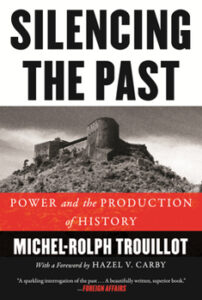 The tower of Trouillot’s theory is embellished as the chapter proceeds. In defiance of evidence, with weak support, Trouillot presumes to know the minds of colonial whites ( every last one of them). The African, in the imagined mind of the colonial white, could never “envision freedom.” If Michel-Rolph Trouillot had only opened Code Des Colons De Saint Domingue, the record of laws regulating French colonial Haiti (from its founding to the year 1789), this tower of nonsense would have collapsed before it could reach even higher into the skies of over-reaching presumption.
The colonial white administration never wore sunglasses that magically obscured the potential of slave rebellion: slave movement was regulated, slave ownership was prescribed, and precautions were routinely taken to limit the independence of slaves. Was slave rebellion “unthinkable” to the royal French government when, in June of 1736, masters of slaves were proscribed from freeing their human property without the written permission of the colonial governor? Was slave rebellion “unthinkable” when the Council of Cap Francois, in 1738, forbade the possession of chemical substances, under penalty of death, in the hands of slaves? Was independent action of colonial slaves “unthinkable” in 1778, when a royal ordinance forbade the transportation of slaves in France without strict prior registration of these individuals? It’s an interesting touch of Michel-Rolph Trouillot, as with so many Haiti scholars, to reduce independent forces to a blur of “white” colonial power. Rarely does he distinguish between laws of the King, those regulations of colonial assemblies, and the conduct of landless whites of lesser influence.
Cracks in the Tower of Trouillot
The white man simply did not understand the aspirations of the African slave for freedom. This is the conceit of Trouillot, as developed in the section “Prelude to the News: The Failure of Categories.” So fervent is the author to underline the slave-tolerant hypocrisies of Western liberals (think:Thomas Jefferson), so avid is he to deplore the complacency of 18th century Europeans in the face of slavery, so righteous is he to indicate the racialist vocabulary in which the pens of these men were steeped, that Trouillot conveniently neglects the voice of French Haiti’s most prominent free man of color, Julien Raymond. This is a convenient omission for Trouillot. When the published words of this non-white slavemaster are disclosed, it appears that even free people of color resisted slave emancipation with the same ferocity of reaction and intolerance as their white counterparts. Raymond speaks loudly in Chapter 2 of The Devil Lives in Haiti, and I here reproduce some of his most memorable defenses of the slave system that had made him as rich as any white colonial of Saint Domingue. This free man of color abhorred the slave insurrection unfolding before his eyes, and he addressed the rebel slaves in the following terms:
The submission to laws, and the good order which must result
from it, are the only things that the nation demands to unite you
to the benefits that the nation is preparing. Return promptly to
good order, lost men, and wait in respectful silence for the laws
which must regenerate you.
If only Michel-Rolph Trouillot had opened the published proclamation of Raymond, the author of Silencing The Past would have discovered the self-deluded elitism of this colored prince of slaveholding:
How many of you would not be happier than them? You, situated
under a sky forever pure; You, having never to suffer the rigors
of winter, with all the miseries and needs that accompany it; You,
lastly, who cultivate with half the trouble a land that produces for
you a hundred times what they cultivate [in France].
If self-delusion is the theme of Michel-Rolph Trouillot’s tower of theory, the self-delusion of free people of color, such as Julien Raymond, enjoys convenient inattention.
The Rhetorical Twister Game of Trouillot
If a white man referred in a figurative sense to colonial oppression as “slavery,” such as Diderot did when he celebrated the American rebellion against King George III, this means he was blind to the racialized slavery of the European empires. If the French national anthem, The Marseillaise, referred to Old Regime France as a time of figurative slavery, this also means Europeans could not tell the difference between the slavery of the plantation and the tyrannies of kings. Are you following? This means, according to the contortions of logic in Trouillot, that the eyes of Europeans confused and diminished plantation slavery to a moral blur.
 Conversely, when a French writer is so awake to the evils of Caribbean slavery, that he publishes his appeal for a Messiah of abolition, “A Black Spartacus,” to deliver all humanity from the stain of slavery, this Frenchman is simply an insincere dabbler in rhetoric. The white man cannot win in the pages of Trouillot. When he weaponizes the image of slavery to achieve a rhetorical effect for an alternate purpose, he is diminishing slavery. When he frontally attacks the real slavery of the plantation, he is diminishing his sincerity. The image of racist sunglasses is not only useful for understanding the theory of Michel-Rolph Trouillot, but is also a useful metaphor for understanding Trouillot’s method. He applies the eyewear when viewing white historical figures whom he abhors. He then removes the eyewear when viewing black historical figures whom he does not.
A Sea of Adoration with Scattered Islands of Dissent
The Racist Sunglasses Theory, as a tower of antiquity may be examined by tourists and scholars alike, has been viewed and examined by academic reviewers since its release in 1995. The challenge to Trouillot’s preposterous theory of the “unthinkability” of the Haitian Revolution is scarce at best amid the sea of critical reviews published since the release of Silencing the Past. Robert L. Paquette (1997) accords the 1995 book an overwhelming respectability, though he does point out that Trouillot “overdraws his case” when reducing all “white” opinion to an amorphous blur. (There is hope after all). Affirmation and celebration of the Trouillot tower is the mood of Robert Gregg’s review of 1998 (Social History), which finds zero fault with the logical and rhetorical over-reaches contained in Silencing the Past. Not a word of dissent, challenge, objection, interrogation, or skepticism is heard from Thongchai Winichakul (1997). The tower of Trouillot enjoys perfect dignity in the estimation of Raymond T. Smith (1997), who is untroubled by Trouillot’s assertion that all knowledge is a product of power, and cannot be bothered to interrogate any of Trouillot’s factual claims about the Haitian Revolution and its reception in the world.
After 18 years of Trouillot’s publication, Alyssa Goldstein Sepinwall (2013) confirms the overwhelming honor enjoyed by Michel-Rolph Trouillot among academics, and herself heaps fresh honor on the Trouillot tower. In large part an objective exploration of the academic reception and legacy of Silencing the Past, Sepinwall joins the club of her colleagues in her passive acceptance of the absurd (and untested) frames of interpretation present in the thoughts of Trouillot.
If there is a voice of courageous dissent in the critical literature of the Racist Sunglasses Theory, this voice belongs to Franklin W. Knight (1997). This reviewer had the guts, amid an academic atmosphere of compliance and complacency, not to indulge an untested, presumptuous, self-serving and self-satisfying work such as that found in Silencing the Past. If only more voices were as courageous as Knight’s, towers of presumption, aiming skyward in their mad ambition, would be denied the dignity of height, brick by audacious brick.